
by Dr Navneet Bhullar
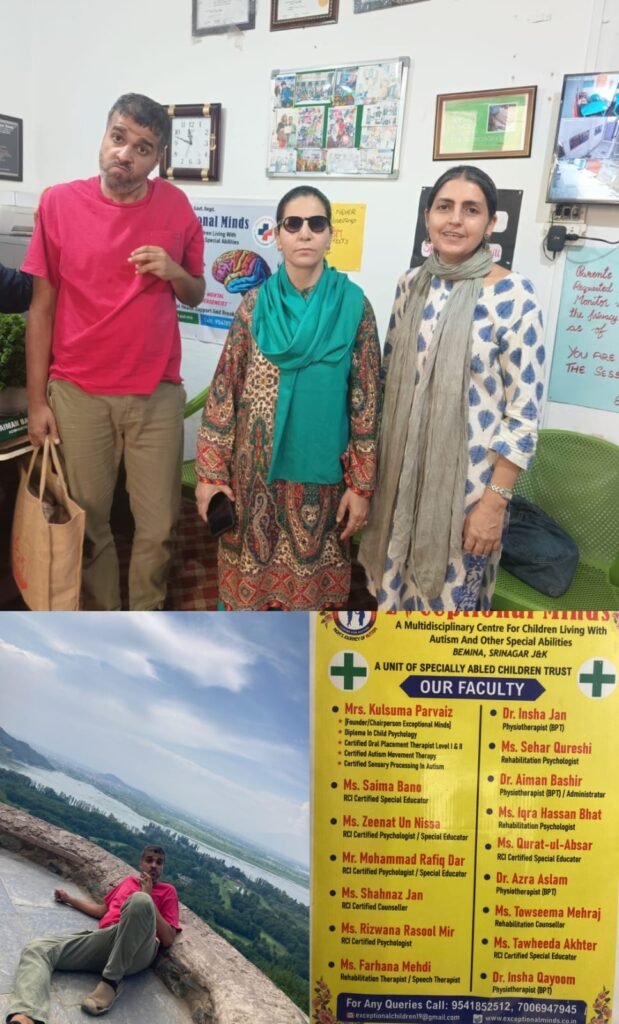
On July 6, 2026, I was in Srinagar where I met Kulsuma Parvaiz, a mother and founder of
Exceptional Minds. My brother Luv and I spent part of our morning at Exceptional Minds where we
met Farmaan Parvaiz, Kulsuma’s tall and handsome 19-year-old son and toured the neat little
establishment where we met about 10 kids.
Exceptional Minds has been in existence since 2019 and their website is here .
It is an impressively staffed NGO (See photo of staff list ). Luv was impatient to set off discovering
more Srinagar. Pari Mahal and Chashma shahi were on our agenda that day.( in this photograph,
Luv is relaxing on a vantage point at Pari Mahal later that day.)
In the following weeks, Kulsuma and I corresponded by email and phone. This conversation is the
result.
NB : We loved Kashmir’s gardens, oh the gardens with natural streams. Harwan was the first one
we entered, thanks to my brother. He had refused to alight from the Smart bus number 1 at Nishad
and we rode on until that last stop Harwan. Bus number 1 is highly recommended for any traveler’s
first day in Srinagar- it is free for women and the disabled. We had a fine free tour of the city via
Lalbagh, mandi, the road embracing Dal Lake and ending in Harwan gardens from where it is a
pleasant walk to the Shalimar Gardens, where common autos and taxis are available to Hazratbal.
I can never resist travel tips Kulsuma. Not enough people are traveling.
Seven Mughal gardens in total Luv and I enjoyed in Srinagar and Anantnag. We saw stooping
elderly with canes in the gardens. Kashmiris picnic in style. Infants. Couples. On elaborate carpets,
we saw feasting families with fine plates and large serving bowls. We were at Kukarnag on a
Sunday at the end of our trip. It was raining, yet the gardens were packed with families. Huge
chinars provided shelter to the picnickers. Families sat inside tents that they had brought.
But not one PIDD was visible. Not one in all those Mughal Gardens, or while strolling in Gulmarg.
Where are they all? Home confined? We saw a little autistic girl on a window seat inside a bus in
Srinagar at 8 pm. Sara was returning home from a therapy centre with her mum.
Her mother asked me hesitantly if Luv is autistic.
So where are all the PIDD?
KP :
Yes, that’s the sad part. They are scared of what people say… some families hide them, some don’t know
any centre exists.
At Exceptional Minds we are trying to spread awareness and trying to change that
NB Thanks for including me in the Jammu Kashmir Whatsapp group. I have seen some great posts
there. A paper on PTSD after ABA therapy. A CRE conference conducted by the government in
Kupwara. That was a pleasant shock to me. You seem to have a government that cares, or is it
part citizen/ civil society efforts ? In Punjab, disability is not on any administration’s agenda, nor the
general public’s. Zilch.
KP: We do have a few schemes from the J&K government like UDID card and some scholarships.
But it’s not even close to what it should be. Government schools do not have special educators as
mandated.
NB : When we met, you had said that neurotypical kids do not interest you.Can you elaborate? I
am fascinated.
KP : Haha, yes I did say that. It’s because the truth is neurotypical kids don’t teach me much. I’ve learned the most from my son
Farmaan.He is autistic. Because of him I learned patience, unconditional love, and how to see the world differently
NB: I see Exceptional minds has an interesting website, photos from elsewhere, AI videos.
Farmaan’s birthday has an avatar saying thank you after the b’day song. Is that for anonymity?
KP : No, I don’t. The AI avatar was just for fun. I am proud of him and I openly share his journey. I
want other parents to feel hopeful too
NB: You have talked of therapy centres after I messaged you my angst about this unregulated
industry. Do you discuss this in your many webinars?
KP: Yes we do talk about it in our webinars and parent meetings. Many centres have become like
money machines. No regulation, no accountability and fees are so high that most parents can’t
afford it. Therapies should be affordable. Because every child deserves to be treated
NB I am very excited about the ongoing Supreme Court case. Renowned disability rights lawyer
Rahul Bajaj is litigating in the case called Zaheer Abbas vs Union of India, asking for regulation of
special needs shelters and rehab centres.
Tell me about Zaheer Abbas Jan, a Kashmiri you know I think.
KP : Yes, I know him. He’s an RCI therapist, and has a MSW. ( Masters in Social Work)
( Kulsuma sent me this link of a new ruling in this ongoing Supreme Court case.)
NB : Is Zaheer a parent also – to a PIDD ?
KP: No
( NB messaged Zaheer but he was unwilling to speak .)
NB : I have seen in our travels that hill states are more open to accepting my brother Luv. In Shimla, Chail
and Mussoorie, random men we have met have chatted with him. He was not treated like a piece of furniture
to be ignored as happens in our naive state, Punjab. In Srinagar’s gardens and on Smart buses, people do
not stare, one family in the enchanting Harwan gardens gave Luv a plateful of their picnic feast. In Jalandhar,
where we have the misfortune of living, people hide their autistic kids. A gynaecologist once visited our home
and stared in shock when Luv walked in and called out for something ( he is non-verbal)- as if he were a zoo
animal . And she was an MD ! You have lived in Gurgaon – how do you see Srinagar compares with Gurgaon
and the NCR in attitudes towards the autistic ? Are the autistic less or more visible in public in Gurgaon?
KP:I don’t think it depends more on the state. It depends on people individually. In places like Gurgaon/NCR, people are generally more aware about autistic kids because there are many centres, therapists, rehab homes and exposure there. So you do see more autistic children out in public, in parks, cafes, and therapy setups. But therapies are way more expensive than anywhere else.
In Srinagar too we are seeing gradual change. People don’t stare as much now, and we’ve had really kind
experiences. But overall visibility is still less compared to metro cities.
NB: What do you see ? Here in Jalandhar. we have seem autistic kids and adults confined
to home as parents are embarassed. Rich people with farmhouses don’t expose their kids
to peers. That is shocking given we are 26 years into the 21st century. How about in
Srinagar? Barmulla? Is there variation in attitudes to autism between major cities and
smaller towns in Jammu and Kashmir?
KP: Here, the richer people do not hide their autistic kids. The poor and less educated hide their kids
sometimes. In villages people seem to send their special needs kids to under-resourced government schools
for respite so the parents may go about their chores.
NB: How about HR – special educators are becoming impossible to recruit in Jalandhar. Punjabis rarely get
into special education. The diploma holders are increasingly from Rajasthan. They prefer to sit unemployedand prepare for government job entrance exams. The quality of special educators who apply is poor- their
language skills, even in their native language, are sub-par. Do you face that?
KP: No. I have not seen that here.There is no shortage of quality special educators here in Kashmir. We are
fortunate. Language skills are good by and large. Very few special educators have been poor at their job.The
majority are efficient.
We need special eds at village level here in Kashmir. Many seem to be opening centres in Srinagar while
they are required in smaller towns. Parents of special needs kids have to travel to Srinagar, stay and bear
the expenses.I trained in Gurgaon and got offers to work there as a partner in a centre, but I declined. “We
need centres in Kashmir,” I declared and moved here in 2019.
NB : Do you see training less educated people on the job at Exceptional Minds as an option, such as high
school educated especially siblings of PIDD?
KP: No, as we follow RCI ( Rehabilitation Council of India) guidelines. Only RCI-licensed staff work here.
But the RCI has also prohibited online courses for occupational therapy and diploma special ed, but these
are happening in India after bribing the RCI. My question to the RCI is why regulate us so strictly. and not
follow your own rules
NB : The Rehabilitation Council of India has a skeleton staff and the welfare of the disabled seems not a job
requirement there. It has long been in bad shape. Isn’t that reason to do what you think is right by our
clients? At Apaar we train and sensitise office assistants, including our van driver. There is no other way to
staff our sheltered workshop in the ongoing HR crisis which seems to be escalating in the last couple of
years.
KP: Here, rehab professionals with RCI licenses expect high salaries, which we as a family trust charging
very affordable fees cannot afford to pay. For us it makes sense to train less qualified but driven persons as
shadow instructors. My domestic help is well-trained by me to take care of Farmaan when I am unwell.
Already, Exceptional Minds is fiscally stretched. My husband pays our electricity bill.
NB: Please take good care of yourself. It is admirable your caregiving at home while trying to help PIDD of
Srinagar and beyond with your free educational webinars. Not seen other NGOs do it. I know how hard that
is. I have been very impressed to see your free night webinars announced in your Whatsapp group.
Your single most ambitious goal for Exceptional Minds?
KP : To have a franchise with branches in Jammu, Sopore, Baramulla.
Earlier my big ambition was to start hostel facilities.But a rehab professional who had worked in a residential
facility for PIDD in Srinagar once told me that some parents do not pick up their kids to take home on Id.
She had to take two hostellers to her home to celebrate Id. My ambition and desire for a hostel at
Exceptional minds ended there and then. Being the primary caregiver of Farmaan is enough work at home
for me.
Another unique Kashmir thing was hesitation to have photographs displayed publicly. I had to edit the group
photo in this collage to remove a female admin. The Exceptional Minds website does not have any staff
photos except Kulsuma’s and a visiting staff group.
Kulsuma had difficulty finding time to answer my questions, emblematic of how hard this work of family
caregiving and community service is. I had expected to publish this interview on our website in August.
I am committed to documenting stories. Patience is a vital ingredient to keep going.